
If it were not for the wide streets and the huge cars, we might have thought we had landed in some version of London. Brick townhouses, bay windows, steps leading up to front doors, trees, elegant façades, restaurants and, above all, people walking the streets rather than just moving between the car and the door. Only everything a little bigger, brighter and more spacious. Or maybe Boston really is a bit of London? A London that crossed the Atlantic almost four hundred years ago, settled in its own way and eventually started speaking with an American accent. But before we began to wonder about that, in the morning we were still in Harwich Port.

We leave Cape Cod a little reluctantly. Over the past few days we have grown used to wooden houses, small harbours, wide beaches, oysters and towns that look as though someone were making sure America did not become too American here. Our Nissan is holding up bravely too. We have already driven it across a good part of New England and it has not complained, although it has one flaw that is becoming genuinely irritating on these roads: the cruise control does not work. Over ten kilometres you can shrug it off. After an hour on an American highway you begin to understand why anyone invented cruise control in the first place. So the right foot does the electronics’ job, the Nissan swallows mile after mile, and we head towards Boston. Only first, Hyannis. Or rather Hyannis Port, because here, for almost a hundred years, one name has been part of the local landscape: Kennedy.

The Kennedys do not come from Cape Cod. Their American story began with Irish immigrants who arrived in Massachusetts in the nineteenth century. Each generation climbed higher in the world of Boston’s Irish Catholics, until Joseph P. Kennedy, father of the future president, built a great business career and the family fortune. In 1928 he bought a house by the ocean in Hyannis Port. Over time the Kennedys bought the neighbouring properties, and so the Kennedy Compound came into being. At first there was no grand politics in it: family holidays, sailing, sport, children, grandchildren and the Atlantic.
Only later did the holiday home of one wealthy Boston family become part of American history. When John F. Kennedy became president, politicians, journalists and guests came here, security appeared, and Hyannis Port began to function almost as a summer White House. Today it is not an attraction you enter with a ticket and an audio guide. And perhaps that is just as well. You drive along quiet streets, look at the water, the elegant houses and the surroundings, and you begin to understand why the Kennedys chose this particular piece of Cape Cod. First came the family holidays. The legend came later.

We continue north. Plymouth is on the way, so once again we drive into the history we have been talking about constantly for days. The Mayflower, the Pilgrims, the first winter, contact with the Native inhabitants, the beginnings of the colony, and later the legend of Thanksgiving.


And a question arises: if Plymouth came first, why did it not become the great city of New England? Why did Plymouth remain relatively small, while Boston grew up a few dozen miles away? The answer is really the story of two different ideas of America. Plymouth was founded by a small group of Pilgrims who, above all, wanted to create a place where they could live according to their religious beliefs, and to survive. Ten years later a much larger wave of Puritans arrived in Massachusetts. They had more people, more money, better organisation and bigger ambitions. On top of that, geography gave Boston an excellent natural harbour. A centre of trade, administration and education took shape. Plymouth was the beginning of the story. Boston had the ambition to create something much bigger. And it did.
Our first encounter with Boston, however, is less historical and more practical. We arrive on Newbury Street, and the receptionist at the Newbury Guest House gives us directions to the car park. It all looks simple. Turn here, then here, and you are there. The problem is that the street we are supposed to turn into looks more like the access road to a rubbish bin than the way to a hotel car park. We look at it and decide it cannot possibly be here. Of course it can. And of course that is exactly where we were supposed to turn. So we wander a little, circle the neighbourhood and after a few minutes come back to precisely the spot we were told to enter in the first place.

Along the way, a first observation about Boston: the drivers are calm. Nobody honks, nobody tries to educate us when we slow down and wonder whether the next alley is a street or the back of a restaurant. For a big American city it is surprisingly peaceful.

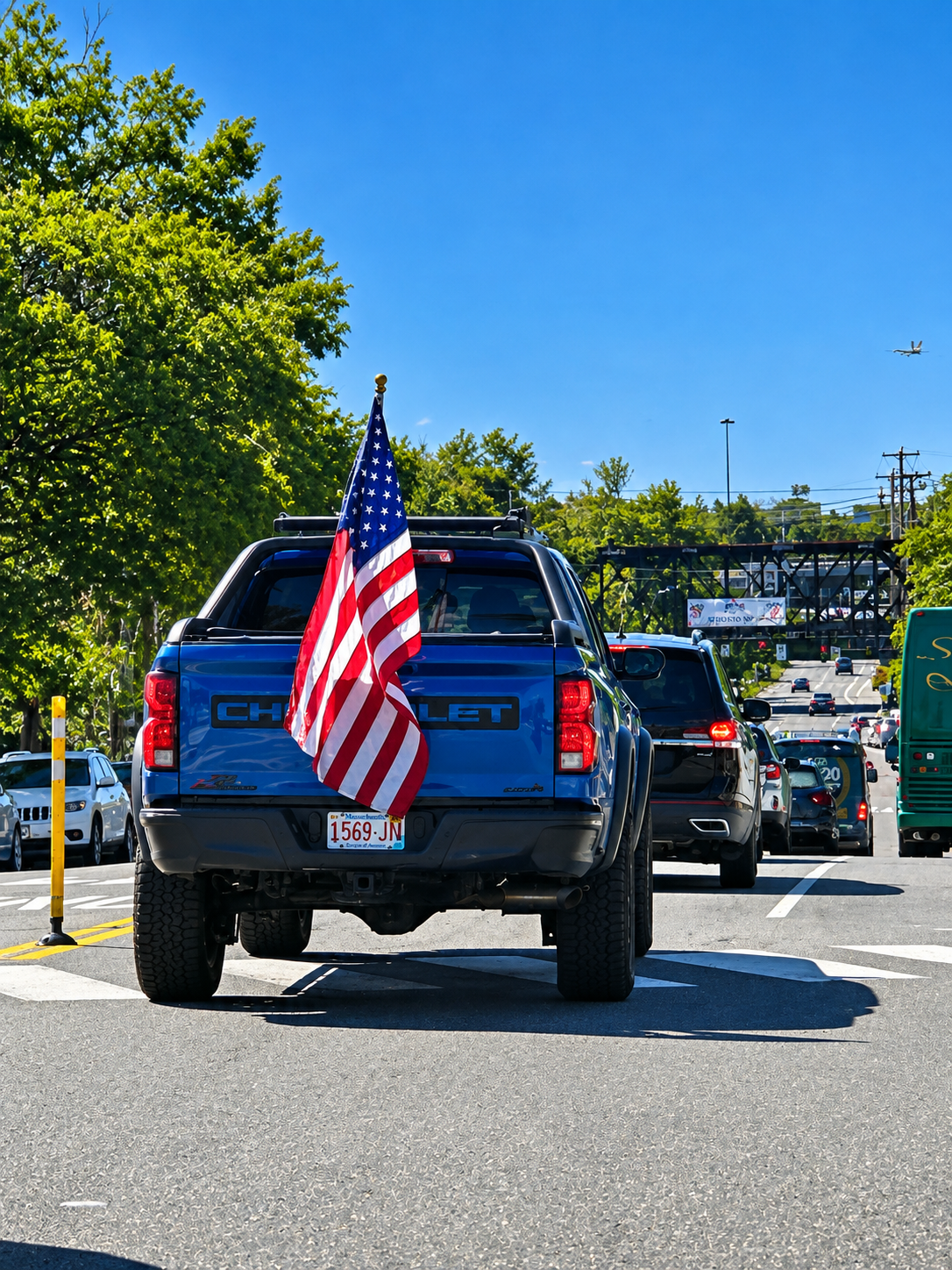
And then we start looking at Boston itself. If it were not for the wide streets and all those SUVs, you could at times forget which side of the Atlantic you are on. Back Bay looks like a cousin of London who left for America long ago, made money, but kept the family manners. Brick, bay windows, steps up to front doors, small shops, cafés, restaurants, trees. Add light façades and plenty of white, which make the city look even more elegant. Everything is on a human scale. After Cape Cod the difference is huge. There, the ocean, dunes, wooden houses and small towns. Here, a compact city where you want to get out of the car. And in America that is not always a given. You can walk. You can look at buildings. You can turn into a side street just because it looks nice. The city does not begin at one car park and end at the next.

So after lunch we set off on foot. Newbury Street, Commonwealth Avenue, the Public Garden, Beacon Hill. We do not want to “do Boston” yet. There will be time for that. On the first day we are more interested in how the city works and how we feel in it. And what you feel here is Europe. Boston does not try to be New York. It does not need to impress with miles of glass or prove that it is a great metropolis. Its advantage lies elsewhere: its history is visible at pavement level. In places it looks as though a piece of old Europe had been moved to the other side of the Atlantic and left for almost four hundred years to slowly grow over with America.

There is also the culinary theme of our whole trip: seafood. We eat it practically non-stop and have no intention of stopping yet. Since we are on the Atlantic and can enjoy fresh fish and shellfish, ordering chicken seems like a wasted opportunity. Clam chowder, oysters, cod, sole, crab, more fish. I am starting to wonder whether, back in Europe, we will avoid anything that swims for a week, but for now we are consistently making the most of where we are.
There is one more thing I did not expect to notice so often: the US Open. We walk into a restaurant: tennis. A bar: tennis. The hotel: tennis. A TV somewhere above the counter: the US Open again. People really do watch this tournament here. Not as an exotic broadcast for a handful of fans, but as a natural part of the end of the American summer. These are the small things I love most about travelling. They are not in the guidebooks, and after a few days they start to say more about a country than yet another monument.
This morning we were still waking up in Harwich Port, in the world of beaches, wooden houses and Cape Cod. Then Hyannis Port and the Kennedys, a little further on Plymouth and the beginnings of America, and a few hours later we are walking around Boston with the feeling that the Atlantic has suddenly become a little narrower. In the evening we go out into the city once more. Where to? We do not know. This time with no plan, no list of sights and no obligation to see the next five places pinned on Google Maps. We will simply see where it takes us.
For now, Boston looks a bit like a London that emigrated to America almost four hundred years ago, widened its streets, bought itself a big SUV and learned to speak with an American accent. Or perhaps that is exactly what Boston really is?























Leave a Reply